The world
Ambryx
A resting place of the old gods — left behind, never reclaimed.
In the beginning
What Ambryx is
In the beginning, the old gods made the resting places — beautiful, silent refuges beyond the reach of time, where a god could lay down the weight of creation and be still. Ambryx was one of them.
Then the new gods took the heavens, and Ambryx was forgotten. No one claimed the inheritance. No one closed the gates. No one demanded the place back. The dusk simply went on — patient, unwitnessed, year after unhurried year.
The magic the old gods left behind did not leave with them. It stayed — ancient, wild, with no master to answer to — and over the millennia it wove itself deeper, down through root and river-stone, until the land itself hummed quietly with it. It is not dangerous out of malice. It is dangerous the way deep water is dangerous: because no one any longer knows where it ends.
It is in this emptiness that Ambryx exists — a place that belongs to nothing and to no one. And precisely because of that: a place where unusual things are possible.
Ambryx is not dark. It is the difference between a room full of shadows and a room whose light has slowly gone out. The first is terrifying. The second is melancholy. Ambryx is the second.
Travellers count four peoples in Ambryx. The Rootbound, oldest and closest to the old magic, keep to the Elderwood; the old power is weather to them — they feel where it lies deep, where it stirs, where not to build and where never to dig. The Settled — by far the most numerous, the people of maps, harbors and early-lit lamps — hold the Evenfields and the southern coast in free towns that answer to no king. The Wanderers are born to a wheel and made by the road-law carved into the waystones; blood gives you a caravan, the rules make you a Wanderer, and both can be lost. And the Bound — descendants of those who once served the old gods — still keep the songs, the offerings, the silences on appointed days, though the purpose is long forgotten, and one part of it is remembered too well. The form outlived its meaning. They do not talk about it.
The Settled and the Wanderers marry freely across their lines. The Rootbound and the Bound keep their blood, and believe it thins; a half-blood belongs to no one. There are no wars over land here — it is a formerly holy place, and people move carefully. But do not mistake that for peace. It only means the darkness stays indoors.
The continent
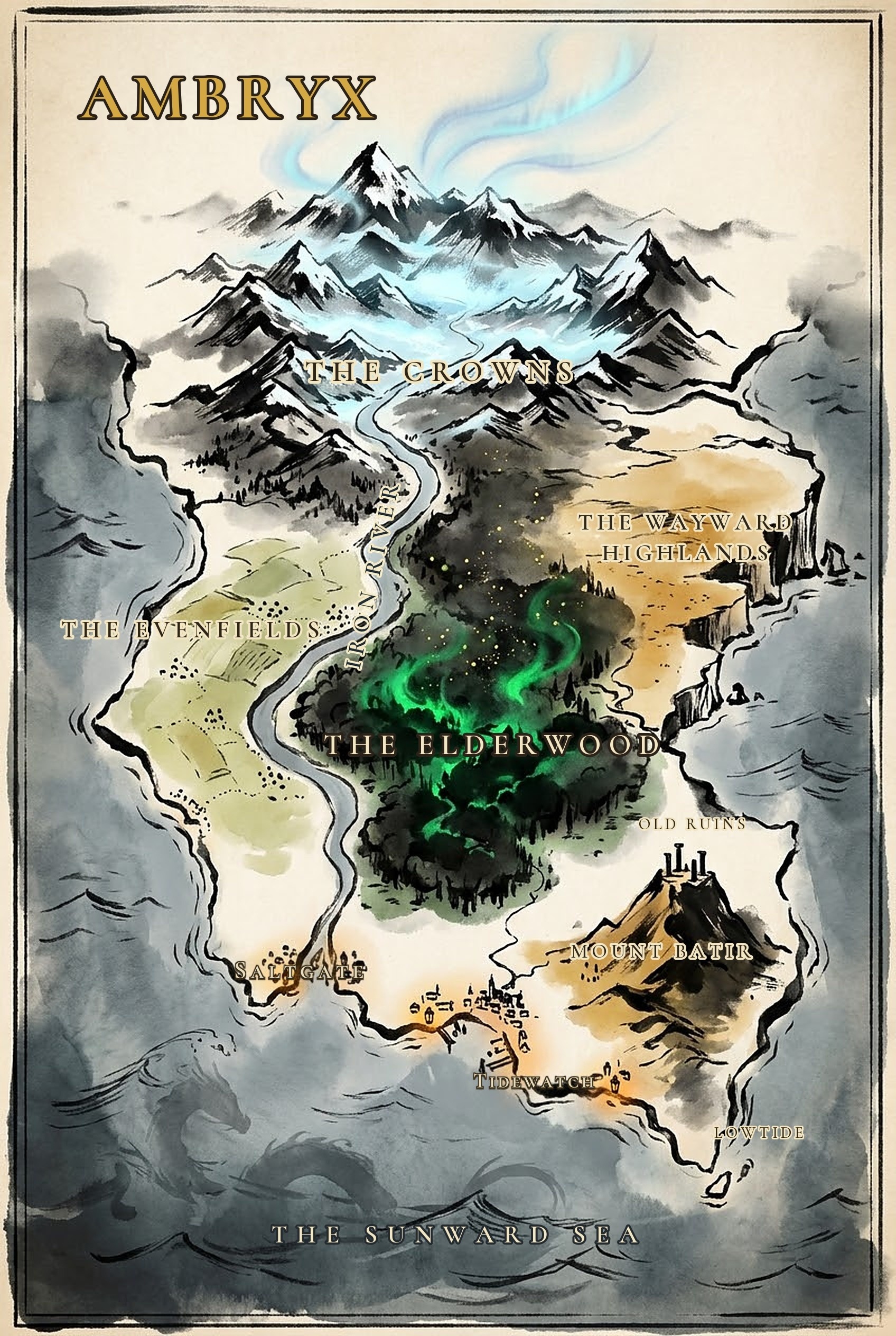
Months of road, one river
From the snows of the Crowns to the warm stone of the southern harbors is a journey of months — and one river runs the whole way down.
The Crowns. The great ranges of the north — sapphire country, where the Bound work their gold valleys and keep their old, unexplained rites.
The Iron River. The continent's one great road. Every boat that matters rides it — even through the dark miles, where no one moors and no one talks loudly.
The Elderwood. The oldest thing on the map. Its edge is on every chart; its interior is on none. Somewhere inside it, unmarked, lies the Glade.
The Evenfields. The Settled's farm country west of the river — hedgerows, small towns, lamps lit early.
The Wayward Highlands. The caravan country of the east: waystones, long roads, and a plateau that breaks off in cliffs above the sea.
The southern coast. Saltgate at the river's mouth, Tidewatch and Lowtide along the shore — and Mount Batir standing over the Old Ruins, where the Listening Court waits.
The Sunward Sea. The only sea anyone has named. The Settled just call it the Salt. No one knows what lies beyond it.
The arena
The Gloaming Glade
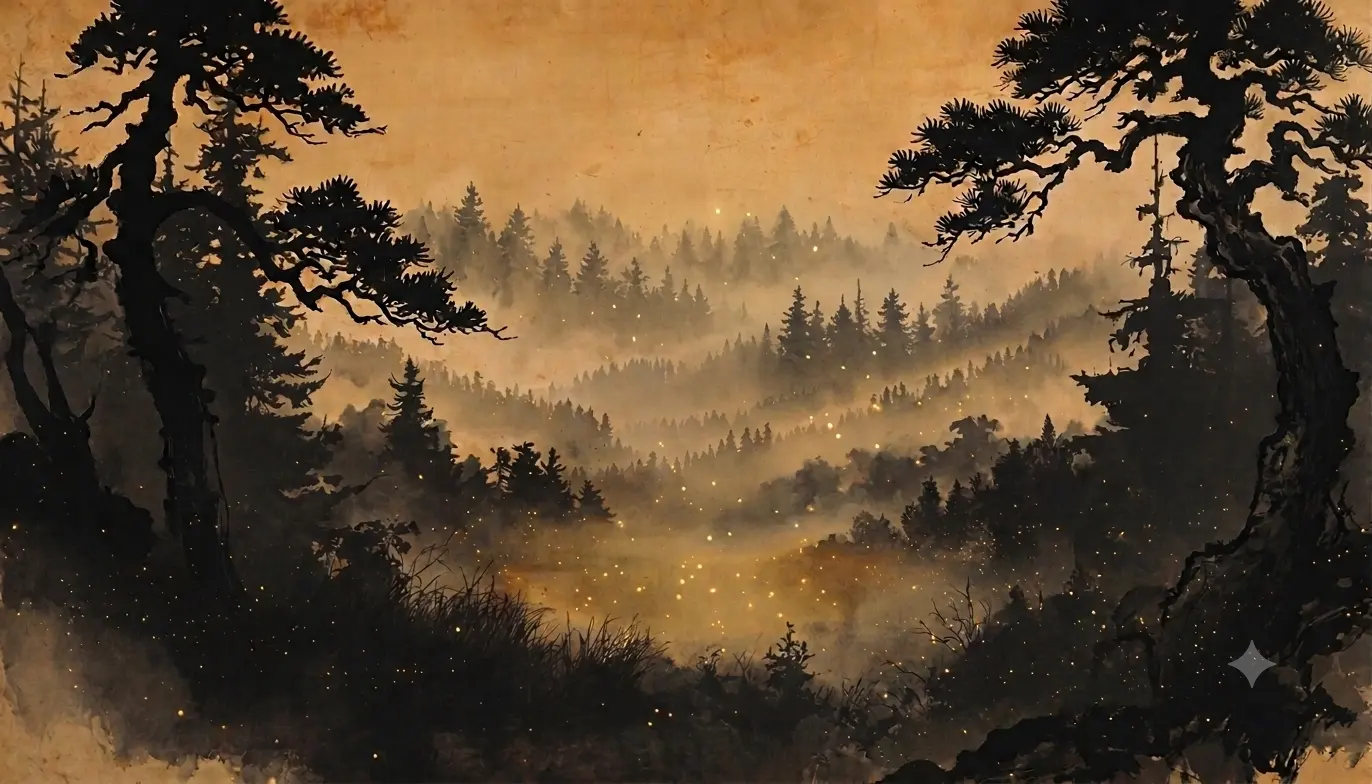
Deep in a forest on no map lies the Glade. It is warm. It is beautiful. It is full of fireflies. And it is unrelenting.
Souls are drawn here that left something unresolved behind them — a debt unpaid, a loss unmourned, a promise never kept. They do not always know why they came. They only know that the way in was easy, and that there is no way out until they have won enough. The Glade has never put a number to enough — and no one in living memory has won their way out. The elders of every people know it. It is the one thing they never say.
The duels fought here are not friendly. They are reckonings, to the death. Two souls step into the warm light. One walks away, a step closer to what it seeks — to return, to remember, to be forgiven, to forget. The other fades, and the Glade glows a little brighter that night.
The fireflies
The fireflies of the Glade are not insects. Every small warm light is a soul that lost its reckoning and faded. Count them, and you will understand: the more beautifully the Glade glows at night — the more were never released.
The unreleased
No one releases the dead
In the beginning, the old gods received what was finished. A duty fulfilled, a promise kept, a prayer finally heard — all of it was carried up and let go, and whoever died finished was allowed to be finished. It was one of the services the world never knew it was getting.
Then the gods left, and no one took over. No one claimed the inheritance. No one closed the gates. And no one releases the dead any more.
So whoever dies with something strongly unresolved — a watch never relieved, an oath, a debt, a prayer never answered — does not quite go out. The old magic does not raise the dead; it forgets to put them out. The form goes on doing the last thing it was: the guard keeps guarding, the column keeps marching, the prayer keeps looking for an ear. Ambryx calls them revenants — where it dares call them anything at all.
Is the soul still in there? It varies — and that is the sorrow of it. Sometimes someone is still standing inside, waiting. Sometimes whatever wore the shape moved on long ago, and only the duty remains, out of habit. No one can tell the difference from the outside. No one in Ambryx can.
Ambryx is not haunted. It is full of unfinished errands.
The wound
The order was broken once
The order the Bound still keep the shape of was a simple one: the gods held the power, and people served. It was broken once, long ago — not by a stranger, but by one of the Bound's own, a son of the people who served, who tried to own Ambryx through the magic instead, and took enough of it to be called a king.
His kingdom is the reason no free town has had a king since: the ancient exception that made the rule. The Bound do not say his name, and the war was never given one on any road in Ambryx. The elders have a single sentence for the whole of that time, and they say it to the young the way you close a door: you know what it cost us last.
The name survives only where the Bound are not the ones speaking — on an old card, in the margin of a chart, in the mouth of a traveller who never had to pay for it: Mordrath, the Hollow King. His kingdom stands empty. And in the emptiness, something still keeps a watch.
He ruled a kingdom of empty crowns. Somewhere a column is still marching to his war. — Printed on an old card. The Bound do not read it aloud.
The duel
What steps into the ring
A reckoning is not fought by two souls alone. The duelist calls, and something answers. What answers depends on where its shape comes from.
The Sworn are drawn from the duelist's own life — the people you knew, the people you owe, the ones sung about at every fire. Your soul musters its company, and they swear to your cause for the length of one reckoning; that is why a deck is called a warband. Each of the Sworn is an image cut from the light of the clearing. The real smith in Saltgate feels nothing when his likeness swings the hammer.
Beasts are real, and borrowed. The interior of the Elderwood is on no map because it is not a place but a threshold — inside the deep, every wild place in Ambryx borders every other. The call goes out through the dark, and a real creature steps in through the treeline as if it had stood one pace away: a frost-beast of the Crowns, a serpent out of the Salt. They answer the way birds rise before a storm — instinct, older than fear. No beast has ever been harmed by the call, and in the way animals know things, they know it.
Revenants are the only ones who are not shaped. They come. A revenant in your warband is an unreleased soul your own soul happens to know — or to owe. And they answer for a reason of their own: whatever falls in the Glade is finally released. Every revenant that steps into the ring is hoping, this time, to be allowed to end.
The duel is to the death. But the Glade takes only what was wagered.
The duelists wagered their souls; the loser fades into the firefly light. A beast wagered nothing, so nothing can be taken — when it falls, the Glade lays it back outside the ring, shaken, breathing, with a memory of somewhere warm. One of the Sworn was never really there. And a revenant wagered its unfinished errand — so when it falls, the Glade takes the errand. Which is to say: it is released. Nothing you summon truly dies in a reckoning. Only the two who wagered themselves have everything to lose.
And yet the duelists come back. Two people who have killed each other twenty times share the clearing, and make small talk about it. The reason is the stones: when a bearer steps into the ring, it is not the soul that stands the wager — it is the stone. And a stone cannot fade. It is made of the same old power as the Glade itself, and the Glade does not consume its own. The debt is written down, every time; it is simply never collected. That is why a bearer rises again after a lost reckoning — and why not one of the fireflies is one of them.
The battlegrounds
Where reckonings are held
The Glade is the first place of power to open its clearing to the duels. It will not be the last. Somewhere out in the dusk, Ambryx is still waking.
The gemstones
What the old gods dropped
Gemstones in Ambryx are not merely rare. They carry a residue of the old divine power — and the rarest of them seem to remember something. Those who learn to wake that power become bearers. The power never comes without a price.
Emerald
Of the Elderwood, the deep primeval forest. Rare, vivid green — bound to growth and to life. One of them hangs around Eidara's neck. She believes she chose it.
Sapphire
Of the Crowns, the great northern ranges. Cold, clear — bound to ice and precision. Aldric took his apart in the dark until it gave in. It was not a gift.
Ruby
Of the southern coast. Deep red, set into a Tidewatch blacksmith's shield — bound to endurance and the blow returned. Harald wears his like a dare: hit me, see what it gets you.
Amethyst
Of the Old Ruins beneath Mount Batir, the Listening Court. Violet, quiet, patient — bound to memory and to borrowed things. Tova carries it for a caravan lost when she was a child — no one's betrayal; a child's mistake, at an adult's price.
Amberstone
The rarest of all, and the only one with no country — it appears where it wants to, which is precisely what makes it feared. It turned up in a snare in the northern Elderwood, in the one trap on Astrid's line that had never caught anything. She wears it on a cord and tells the story often. What the stone is for is a question that weighs on all of Ambryx.
Spectrolite
The one stone nobody found. Near-black and visibly made of pieces — a storm of fragments cemented into one, flashing green, blue and violet when the light turns. Great stones choose their bearers; small stones cannot say no. Skarn built the difference, and one facet still stands empty.
The Law of Stones: when one bearer's woken power meets another's, a compulsion older than either takes hold — destroy the other, or be destroyed. It is, as far as anyone knows, one true reason bearers are drawn to places like the Glade. Not always by choice. — Whispered among the Bound
The characters
Drawn to the Glade
All of them are outcasts — none fully belongs to any people, and each carries a debt with a name on it. It is part of what pulled them here.
Read enough. Walk in.
The Glade explains nothing. It just lights up, and waits to see who you brought.
Play FreeFree · in your browser · Open Beta